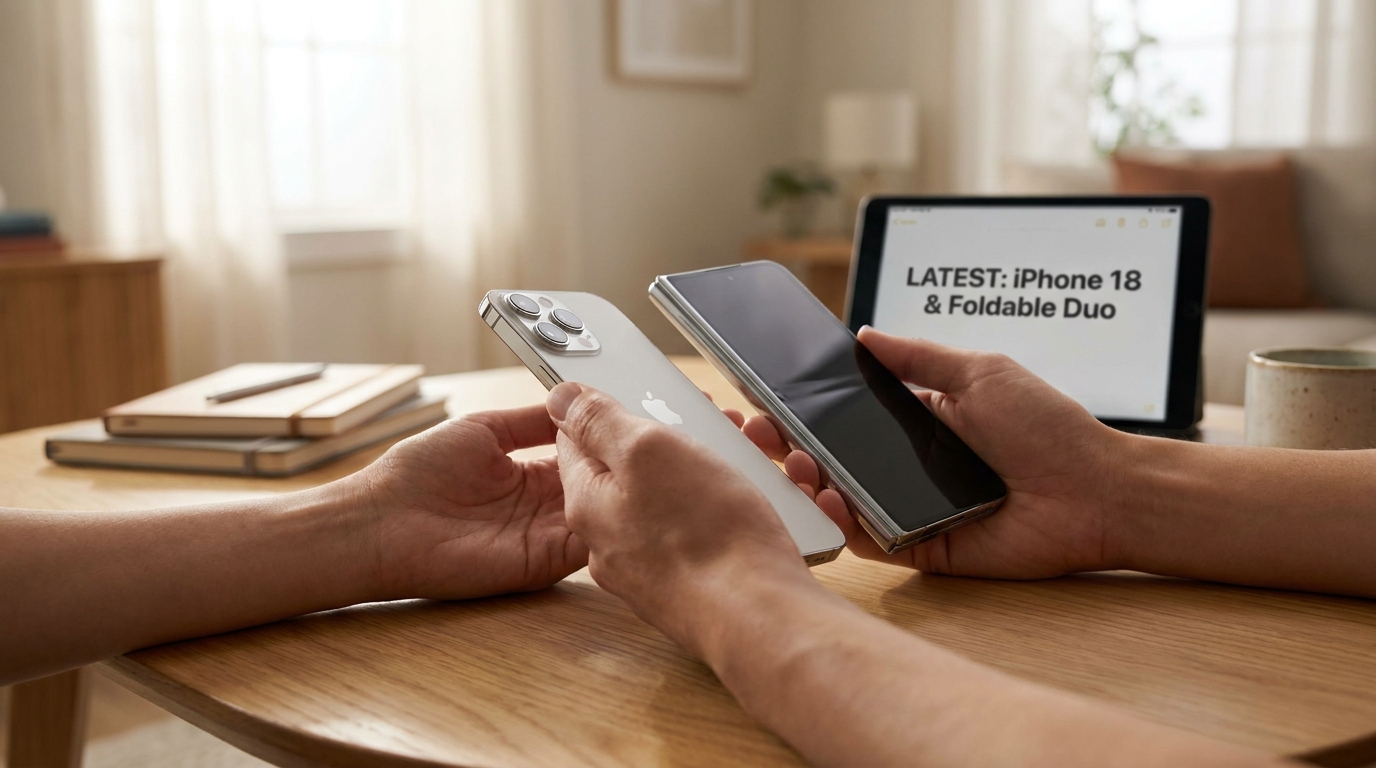
Have you ever wondered if Apple would actually pull the trigger on a foldable phone? The 'Surprise and shine' event just changed the game for the iPhone 18 lineup, introducing the powerful Pro models alongside the long-awaited iPhone Duo. It is a huge break from the usual September routine that has everyone asking if the wait is finally over.
This year is unique because Apple is using a staggered release schedule. While the Pro models and the iPhone Duo are hitting shelves in late 2026, the standard versions are waiting until Spring 2027. It is a move that prioritizes high-end power, especially with 12GB of RAM becoming the new standard for a Siri that actually works the way we want.
This article explores the new hardware, the £1,999 price tag of the foldable, and the 2-nanometer tech inside the A20 Pro chip. You will see why the cooling system matters for AI and get a clear answer on whether you should buy now or wait for the Spring launch.
Apple’s iPhone 18 and the New Foldable Duo: What You Need to Know
The 'Surprise and shine' event on September 9, 2026, changed the iPhone roadmap forever. Apple is ditching its usual single-launch habit and splitting the release between Fall and Spring. The focus is now on the high-end: the iPhone 18 Pro, Pro Max, and the foldable iPhone Duo. If you were waiting for the standard iPhone 18 or the budget-friendly 18e, you will have to wait until Spring 2027.
UK pre-orders for the Pro models start September 12, with the Pro starting at £1,199 and the Pro Max at £1,299. These are not just minor tweaks. With the A20 Pro chip and 45-hour battery life on the Pro Max, these phones are built for heavy AI workloads. You will likely need the 12GB RAM model to get those expressive new Siri voices to run locally without a hitch.
The real star of the show is the £1,999 iPhone Duo. Apple's first foldable finally arrives with pre-orders on October 16. It sports a 48MP Pro Fusion camera and a smaller Dynamic Island that handles three live activities at once. It is a massive investment, but for those who have been waiting for an Apple foldable, the wait is officially over.
Key insights:
- Apple is moving to a split-release schedule, launching premium models in September and standard models in the Spring.
- The iPhone 18 Pro Max features the longest battery life ever in an iPhone at 45 hours.
- The iPhone Duo is Apple's first foldable device, priced at £1,999 with an October release date.
The New Split Launch Schedule: Why Some Models are Taking Longer
Apple is moving away from the old tradition where every single new device dropped on the same Friday in September. For years, we expected the whole lineup to arrive at once, but the 2026 release cycle tells a different story. If you are looking for the high-end Pro models or the much-discussed foldable Duo, you are at the front of the line. However, if you were hoping to pick up a standard iPhone 18 or the more affordable 18e, you will have to wait until Spring 2027. This shift marks a major change in how the company manages its flagship hardware and global supply chains.
Recent findings show that the priority for late 2026 is clearly on the premium tier. At the 'Surprise and shine' event on September 9, it became obvious that the Pro models and the new Duo are the stars of the show. These devices carry the heavy-duty A20 Pro chips built on a new 2-nanometer process, which require more specialized manufacturing. By focusing on these first, Apple can ensure that its most demanding users get the best performance and the latest AI capabilities without being slowed down by the massive production volumes needed for the cheaper models.
What does this mean for the rest of the lineup? The standard iPhone 18 and the 18e are now expected to launch in Spring 2027. While it might feel like a long wait, this delay allows Apple to focus its attention on refining the entry-level experience. Think of it as a second wave of excitement. Instead of the standard models getting lost in the Pro hype, they get their own moment to shine later in the year. This also helps Apple maintain interest in their products long after the initial September buzz has faded away.
If you have your heart set on the Pro series, you need to mark your calendar for September 12, 2026. That is when UK pre-orders for the iPhone 18 Pro and Pro Max officially begin. The Pro starts at £1,199 while the Pro Max will set you back at least £1,299. If you manage to get your order in early, you can expect to have the phone in your hands by September 18. This quick turnaround is great for those who want the new 48MP Pro Fusion camera and that improved battery life as soon as possible.
The timeline for the foldable iPhone Duo is a bit different. Pre-orders for this ambitious device do not open until October 16, 2026. Because it is a brand new category for Apple, they are taking a few extra weeks to get the logistics right. If you are ready to spend the £1,999 asking price, you should see availability starting on October 23. This staggered approach for the Duo helps manage the high demand for what is likely to be a limited-stock item during its first few months on the market.
You might wonder why a staggered launch actually benefits you as a buyer. Here is the thing: it makes stock availability much easier to manage for the high-demand Pro models. In the past, trying to buy a Pro Max on launch day was often a nightmare of shipping delays and out-of-stock notices. By moving the standard models to the spring, Apple frees up its production lines to focus entirely on the Pro and Duo. This means you have a better chance of getting the exact color and storage capacity you want without waiting months.
Also, this split schedule gives Apple more time to polish the software and hardware for the standard versions. Instead of rushing four or five different phones out the door at once, they can focus on making the 'e' and standard models as stable as possible. It also spreads the excitement across the entire fiscal year. For us, it means there is always something new to look forward to, rather than everything happening in one chaotic month and then nothing for the next eleven. It is a smarter way to handle a lineup that has grown too large for a single release date.
Key insights:
- Apple is moving to a biannual launch cycle to maintain year-round consumer interest.
- The Pro models and the iPhone Duo are the priority for the late 2026 holiday season.
- Standard iPhone 18 and 18e models are being held until Spring 2027 to allow for better software polish.
- Staggered pre-order dates help manage stock availability and reduce launch day shipping delays.
Mark Your Calendar: Key Pre-order and Release Dates
If you are planning to grab the next big thing from Apple, you will want to set some alarms soon. The 'Surprise and shine' event on September 9, 2026, officially kicked things off, but the real action starts just a few days later. For the iPhone 18 Pro and Pro Max, UK pre-orders open on September 12. You will not have to wait long after that, as they hit shelves on September 18. It is the classic Apple rhythm we have come to expect for the high-end models.
But here is the catch. Apple is trying something new with a staggered launch strategy this time around. If your heart is set on the foldable iPhone Duo, you will need a bit more patience. Pre-orders for that device do not start until October 16, with full availability on October 23. It is a bit of a wait, but for a device priced at £1,999, it gives you a few extra weeks to decide if you are ready to make the jump to a foldable screen.
What about the standard iPhone 18 or the budget-friendly 18e? You might be waiting until Spring 2027 for those. By spreading these releases out, Apple is moving away from its traditional single-event cycle to keep people talking all year. Whether you are eyeing the Pro Max at £1,299 or the futuristic Duo, the next few months are going to be busy for anyone looking to upgrade.
Key insights:
- Pro models (18 Pro/Pro Max) pre-orders start September 12, 2026.
- The foldable iPhone Duo pre-order window opens much later on October 16.
- Standard and 'e' models are delayed until a separate Spring 2027 launch.
- UK pricing ranges from £1,199 for the Pro to £1,999 for the Duo.
Why a Staggered Launch Actually Benefits You
Why is Apple making us wait for the standard iPhone 18 until Spring 2027? It might feel like a delay, but this split launch is a win for you. Usually, everyone rushes the store at once and stock vanishes. By launching the Pro models first on September 18, Apple keeps availability higher for those high-demand devices.
Also, the tech needs time to breathe. The A20 Pro chip is a powerhouse, and the Pro Max offers 45 hours of video playback. Pushing the e and standard versions to spring gives Apple more time to polish the experience. You get a better product because they are not rushing five different phones out the door at once.
This keeps the hype going all year long. We get the Pro series in September, the foldable Duo in October, and then more choices in the spring. It spreads out the excitement and helps you make a better buying choice instead of feeling pressured to buy everything during a single week in September.
Key insights:
- Staggered releases mean fewer stock shortages for the popular Pro models.
- Spring launches for standard models allow for better software and hardware polishing.
- A year-round release cycle keeps consumers engaged and prevents a single fall bottleneck.
Is the iPhone Duo Worth £1,999? A Look at Apple's First Foldable
So, let's talk about the elephant in the room: that £1,999 price tag. It is a massive jump from the £1,199 you would pay for a standard iPhone 18 Pro. But Apple isn't just selling another phone here. They are trying to sell you a new way to work and play. After years of watching from the sidelines while other brands experimented with flexible screens, Apple finally showed their hand at the 'Surprise and shine' event. They are betting that you will pay a premium for a foldable that actually feels like a finished product rather than a prototype.
The design philosophy is all about making the flexible screen feel like a natural evolution. With the new Ceramic Shield 2, Apple claims the Duo has three times better scratch resistance than the iPhone 16 Pro. This is a big deal because durability is usually the first thing people worry about with foldables. You are getting a device that aims to be as tough as a slab phone but with the ability to expand when you need more room. It is a bold move that positions the Duo as a luxury tool for people who want the best of both worlds.
When you flip it open, the 'Ultra' experience really takes over. It is basically like having an iPad and an iPhone fused into one pocketable frame. Thanks to the A20 Pro chip, which is built on a tiny 2-nanometer process, the Duo handles heavy multitasking without breaking a sweat. You can run multiple apps side by side, and the redesigned Dynamic Island can even show three Live Activities at once. It is built to be a thermal management powerhouse, meaning it can handle intense AI tasks and gaming without getting uncomfortably hot in your hands.
If you are planning to get one, keep in mind that the Duo follows a slightly different schedule than the rest of the lineup. While the iPhone 18 Pro and Pro Max are available in September, Duo pre-orders do not start until October 16, with the device hitting shops on October 23. This staggered launch shows that Apple is being careful with its first foldable. For those who need a device that replaces both their phone and tablet, the Duo might be the first time a foldable actually feels worth the investment.
Key insights:
- The £1,999 price reflects a hybrid device that replaces both a phone and a tablet.
- Ceramic Shield 2 addresses the main foldable pain point by offering 3x better scratch resistance.
- A staggered October release date suggests Apple is prioritizing a smooth rollout for its new form factor.
The 'Ultra' Experience in a Foldable Form Factor
What if you could fold your iPad and slide it into your pocket? That is the big promise behind the iPhone Duo. Apple is finally entering the foldable market this October, but it is more than just a phone that bends. It is a hybrid that pulls the best features from both the iPhone and iPad into one frame. For £1,999, you get a device that handles multitasking in ways a standard Pro Max cannot. Imagine tracking three different Live Activities at once on a display that actually has the room to breathe.
Foldables often feel fragile, which is why the new Ceramic Shield 2 matters so much here. It is three times more scratch-resistant than previous versions, aiming to settle those durability fears once and for all. This is vital because the Duo is built to be a daily workhorse. With the A20 Pro chip and its next-gen cooling, the device stays fast even when you are pushing the limits of Apple’s new AI features. It is a massive leap for anyone tired of switching between two different gadgets all day.
Key insights:
- Ceramic Shield 2 offers 3x better scratch resistance to protect the foldable display.
- The Duo acts as a hybrid, merging iPad-style multitasking with iPhone portability.
- A £1,999 price point positions it as the premium 'Ultra' option in the 2026 lineup.
Why 12GB of RAM is the Real Star of the iPhone 18 Pro
When you look at the new iPhone 18 Pro, it is easy to get distracted by the sleek frame or the massive screen. But the real story is something you cannot even see. Apple is bumping the RAM up to 12GB. While that might sound like just another technical spec, it is actually the secret sauce for the next generation of Siri. Think of it as giving the phone a bigger brain to store more complex thoughts at once.
Why does this matter for you? If you have ever wanted Siri to sound less like a robot and more like a person, you need that extra memory. The new Expressive Voice features require a lot of heavy hardware lifting. Older models with less RAM will likely struggle to keep up, leading to lag or simplified responses. By packing in 12GB, Apple ensures that these AI interactions happen instantly without needing to send your requests to a far away server.
This leads to a big win for your privacy. We often hear about on-device AI sovereignty, which is just a way of saying your data stays on your phone. Because the 12GB of RAM can handle complex AI tasks locally, your personal conversations and habits do not have to leave the device. It is a win for speed and a massive win for security because your information never touches the cloud.
Under the hood, the A20 Pro chip is doing the real magic. Built on a tiny 2-nanometer process, this chip is incredibly efficient. It features a 6-core CPU and a 16-core Neural Engine that works alongside new Neural Accelerators. You might wonder what those actually do. Basically, they take over small, repetitive tasks like photo processing or text prediction so the main processor can focus on the big stuff without breaking a sweat.
This efficiency is how Apple can claim a record-breaking 45-hour battery life for the Pro Max. It is not just about having a physically larger battery. It is about a smarter chip that knows how to sip power instead of gulping it. Whether you are gaming or just scrolling through your feed, the A20 Pro keeps things cool and fast without draining your juice by lunchtime.
Key insights:
- The 12GB RAM upgrade is essential for running the next version of Siri locally without lag.
- Privacy is improved because more AI tasks stay on the device instead of being sent to the cloud.
- The 2-nanometer A20 Pro chip is the key to reaching that 45-hour battery life claim.
- Neural Accelerators handle background tasks to keep the main processor free for heavy apps.
The A20 Pro Chip: 2-Nanometer Magic
Most of us do not think about nanometers when we are scrolling through social media or editing a quick video. But the jump to a 2-nanometer process in the A20 Pro chip is a huge deal for the iPhone 18 Pro. It is basically about fitting way more power into a tiny space without turning your phone into a pocket-sized heater. This matters because it allows the phone to work harder while actually using less energy.
Under the hood, this chip runs a 6-core CPU and a 16-core Neural Engine. What does that actually mean for your daily life? It means the phone handles complex AI tasks right on the device instead of sending your data to a distant server. Apple also added something called Neural Accelerators. Think of these as dedicated fast lanes for Siri and speech-to-text. They make every interaction feel snappy and private because the processing happens instantly in your hand.
The real magic shows up in the battery life. Because the 2nm process is so efficient, the iPhone 18 Pro Max can now hit up to 45 hours of video playback. That is the longest we have ever seen in an iPhone. To keep things from getting too hot while you game or use those new AI tools, Apple also included a next-generation vapor-chamber cooling system. It is built to handle the heavy lifting without forcing the phone to slow down when things get intense.
Key insights:
- The 2nm process allows for much higher performance without draining the battery quickly.
- Dedicated Neural Accelerators keep AI tasks like Siri running locally for better speed and privacy.
- New vapor-chamber cooling helps manage the heat generated by the powerful A20 Pro chip during long tasks.
Staying Cool: How Apple Solved the AI Overheating Problem
Ever noticed your phone getting warm just from using a few smart features? It is a real problem. With the iPhone 18 Pro, Apple is finally tackling the heat that comes with heavy AI tasks. While high-end gaming used to be the biggest battery and heat drain, on-device AI is actually harder on the hardware. To fix this, they have added a next-generation vapor-chamber cooling system. This isn't just about comfort; it is about keeping the A20 Pro chip running at full speed without slowing down when things get intense.
This new thermal setup is a big part of why the Pro series stands out this year. Think of it like a high-performance car needing a better radiator. Because the A20 Pro chip is built on a tiny 2-nanometer process, it packs a massive amount of power into a small space. Without this cooling, those advanced Siri features and local AI processing would quickly turn your phone into a pocket heater. By managing the heat better, Apple ensures you get the longest battery life yet - up to 45 hours on the Pro Max - without the hardware having to throttle its own speed.
But the hardware wins do not stop at cooling. The 48MP Pro Fusion camera system is getting a massive upgrade with a new variable aperture. If you have ever wanted that blurry background look in photos without relying on glitchy software effects, this is a game-changer. It gives you real, physical control over depth of field. This means much better low-light shots for the Pro Max and more natural-looking portraits that do not look like they were processed by an algorithm. You get pro-level results from a device that still fits easily in your pocket.
Key insights:
- Vapor-chamber cooling is now essential for handling local AI processing without performance drops.
- The A20 Pro chip uses a 2nm process to balance power with the heat demands of on-device intelligence.
- Variable aperture on the 48MP Pro Fusion camera offers hardware-level depth of field for more natural photos.
Better Photos Without the Bulk
Have you ever felt like you needed a massive DSLR just to get that perfect, blurry background in a portrait? With the iPhone 18 Pro series, that's changing. Apple is bringing a physical upgrade to the 48MP Pro Fusion system that moves beyond just clever software tricks.
The big news here is the new variable aperture. Instead of relying on software to fake a shallow depth of field, the lens actually adjusts. This means you get natural, pro-level bokeh that looks authentic because it is. If you're eyeing the Pro Max, the low-light performance is where you'll really see the jump. It captures more detail in those dim restaurant shots or late-night walks without the noise we're used to seeing.
It's all backed by the A20 Pro chip, which handles the heavy lifting behind the scenes. When these devices arrive on September 18, 2026, the focus won't just be on the bigger screens. It'll be about how much power is packed into a phone that still fits in your pocket. You're basically getting a studio-quality camera without the extra gear bag.
Key insights:
- Natural bokeh from a physical variable aperture lens.
- Significant low-light improvements specifically for the Pro Max model.
- Studio-quality results without needing bulky external equipment.
The Verdict: Should You Upgrade Now or Wait for Spring?
So, is it time to open your wallet or keep it shut until next year? Apple is trying something new by splitting their lineup across two seasons. If you want the most power right now, the iPhone 18 Pro and Pro Max are the clear winners. With the new A20 Pro chip and that massive 45 hour battery life on the Max, these phones are built for people who live on their devices. They arrive in shops on September 18, but they come with a hefty price tag starting at £1,199.
Then there is the iPhone Duo. This is Apple's big swing at the foldable market, but being first comes with a literal price. At £1,999, you are paying a massive early adopter tax for that folding screen. It does not even arrive until late October. If you love being on the bleeding edge and have the budget, go for it. But for most people, waiting to see how that hardware holds up in the real world is probably the smarter move.
What if you just want a solid phone without the four figure price? That is where the spring launch comes in. By waiting until early 2027, you can grab the standard iPhone 18 or the 18e. This staggered release means Apple is keeping us on our toes all year. If your current phone is still holding a charge and taking decent photos, waiting a few more months for the budget friendly models might be the best choice you make this year.
Key insights:
- The Pro models are best for power users who need the A20 Pro chip for heavy AI tasks.
- The £1,999 iPhone Duo is a luxury choice for those who want to lead the foldable trend.
- Waiting for the Spring 2027 launch is the best path for budget conscious buyers.
Frequently Asked Questions
When can I buy the iPhone 18 Pro in the UK?
You'll be able to pre-order the iPhone 18 Pro in the UK starting September 12, 2026. If you'd rather wait to pick it up in person or have it delivered, the official release date is September 18. This follows the big 'Surprise and shine' reveal event Apple has planned for September 9.
It is worth noting that Apple is using a split launch strategy this time. While you can get the Pro and the new foldable Duo in the autumn, the basic iPhone 18 and 18e won't actually arrive until spring 2027. So, if you want a new phone before the year ends, the Pro models are your best bet.
How much does the foldable iPhone Duo cost?
The iPhone Duo is set to launch at £1,999 in the UK. It is definitely a high-end price point, but that is because it is Apple's first ever foldable device. For comparison, the iPhone 18 Pro Max starts at £1,299, so you are paying quite a bit more for that folding screen technology.
If you are planning to buy one, the timeline is slightly different from the other models. Pre-orders for the Duo don't start until October 16, 2026, and you'll be able to get your hands on it starting October 23. It's a big investment, but it comes packed with the A20 Pro chip and a redesigned Dynamic Island that can handle three activities at once.
What is the difference between the A20 and A20 Pro chips?
Think of the A20 Pro as the heavy-lifter of the bunch. While the standard A20 is plenty fast, the Pro version is built on a tiny 2-nanometer process that makes it way more efficient at handling big tasks. It comes with a 6-core CPU and a 7-core GPU, plus a special dual Neural Engine that is specifically there to make Apple's new AI features run like a dream.
Here is the thing: it is not just about speed. The Pro chip is paired with better cooling and more RAM, which is what those fancy new Siri voices and AI tools really need. Whether you are multitasking or just scrolling through thousands of cute cat photos, the Pro chip is where you will see the most benefit.
Why is the standard iPhone 18 delayed until 2027?
Apple is actually trying something pretty different this time around. Instead of dropping every new phone in September, they are moving to a split launch. They want to give the high-end Pro models and the new foldable iPhone Duo their own moment in late 2026, then follow up with the standard iPhone 18 and the 18e in the spring of 2027. It is a bit like how a cat decides to nap now and play later. They are just spacing things out.
It basically means we get new gadgets to talk about all year long instead of just once every twelve months. While it might be a bit of a wait if you want the base model, this new schedule helps Apple keep the momentum going. So, if you are holding out for the standard version, just think of it as a spring treat to look forward to.
Conclusion
So where does this leave us? We are seeing a big shift as Apple finally joins the foldable world with the iPhone Duo while giving the iPhone 18 Pro the power needed for next-level AI. The split launch might feel different, but it shows that Apple is focusing on getting the high-end tech right first instead of rushing everything out at once.
If you are a power user, the extra RAM and new cooling system are the real stars of the show. They keep everything fast and chilled even when the AI features are working hard in the background. The Duo is a big swing for the company, but it is perfect for anyone who wants a tablet and a phone in one pocket.
Your next move is to check your budget and your needs. If you want the newest tech now, the Pro and Duo models are the clear choice this fall. But if you want a reliable upgrade without the premium price, waiting for the spring might be better. Either way, the future of the iPhone looks very bright.